


The Trend Of High-Capacity E-Cigarettes Reflected By The ELFBAR BC45000
Jun 16, 2026
Over the past decade, the e-cigarette industry has undergone multiple rounds of product iteration. Evolution has moved rapidly-far outpacing many other consumer electronics sectors-from early compact devices designed primarily as simple alternatives to today's products, which integrate display systems, rechargeable batteries, and high-capacity liquid reservoirs.
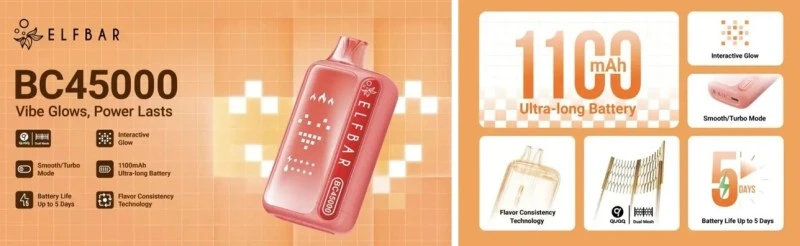
Among the various product types, high-capacity e-cigarettes have emerged as a key area of market focus. Products like the ELFBAR BC45000 exemplify recent industry advancements in battery life, atomization technology, battery management, and user experience. Regardless of whether a consumer personally uses these products, from an industry development perspective, such devices reflect the new phase the e-cigarette sector is currently entering.
1. From Low to High Capacity: The Evolution of Product Form

When e-cigarettes first entered the mainstream, device designs were relatively simple.
Early products typically featured:
Small liquid reservoir capacity
Limited battery capacity
Minimal functional features
A short usage lifespan
This design approach made sense during the industry's infancy, as manufacturers prioritized portability and the implementation of basic functions.
As user demands grew, products emphasizing extended battery life began to appear on the market. Manufacturers realized that consumers wanted to replace devices less frequently and desired products that lasted longer.
Consequently, high-capacity devices began to enter the mainstream market.
2. Shifting User Demands
A look at consumer discussions in recent years reveals a distinct shift in priorities.
In the past, users often asked:
"What flavor is this product?"
Today, more people ask:
"How long does it last?"
"Is performance consistent over time?"
"Is it convenient to charge?"
This shift indicates that the market is moving away from competition based on single specifications toward competition based on the overall user experience.
For many consumers, capacity is merely a baseline requirement; stability and convenience are what truly shape the long-term user experience.
3. The Development of Mesh Coil Technology
Technological progress in the e-cigarette industry is largely driven by advancements in atomization systems.
While traditional coil structures dominated the early industry, their limitations became apparent as product capacities increased.
As a result, Mesh Coil technology has become increasingly widespread.
Its key features include:
Larger heating surface area
The mesh structure expands the contact area with the e-liquid.
More uniform heat distribution
Reduces the occurrence of localized overheating. Improving Atomization Efficiency
It facilitates a more thorough participation of the e-liquid in the atomization process.
In recent years, many high-capacity devices have adopted similar solutions, indicating that this technology is gradually becoming a standard industry feature.
4. Why the Dual-Mesh Coil Structure Is Gaining Attention

As product capacities increase, single heating systems face new challenges.
Some devices have begun adopting dual-mesh coil structures.
From an engineering perspective, the core objective is not merely to boost output, but to enhance overall stability.
High-capacity products require a longer usage lifecycle; therefore:
Output consistency becomes crucial.
Temperature control requirements become stricter.
Reliability during prolonged operation becomes a key metric.
The dual-mesh coil design emerged against this backdrop.
5. Battery System Upgrades
The development of the e-cigarette industry relies not only on atomization technology but also heavily on battery technology.
High-capacity designs would be difficult to realize without more reliable power supply systems.
Several distinct trends have emerged in the industry recently:
Widespread adoption of Type-C ports
Unified standards improve compatibility.
Rechargeable designs becoming mainstream
Supporting longer usage cycles.
Optimization of battery management systems
Improving safety and energy efficiency.
These changes parallel the development trajectory of consumer electronics.
6. Display Systems Becoming a Mainstream Feature
In the past, e-cigarette devices rarely featured displays.
The reason is simple:
Device functionality was limited, so there wasn't much information to display.
However, as product architecture has become more complex, the importance of display systems has grown.
Users want to know:
Battery status
Device operating status
Usage progress
Consequently, LED displays have evolved from a high-end feature to a common one.
7. User Experience Becomes the New Competitive Focus

The e-cigarette industry long competed primarily on technical specifications.
However, as the market matures, relying solely on numbers makes it difficult to establish a competitive edge.
Consumers are now focusing on:
Ease of use
Transparency of information
Long-term performance stability
Product design quality
This shift mirrors the development paths of many mature industries.
Once technology becomes widespread, the focus of competition often shifts toward optimizing the user experience.
8. Changes in the Global Market
Different regions have distinct demands for e-cigarette products.
For example:
European market
Places greater emphasis on regulatory compliance and product quality.
North American market
Focuses on innovative features and user experience.
Middle Eastern market
Favors products with diverse flavor profiles. Southeast Asian Market
There is a focus on balancing price and functionality.
These differences are driving manufacturers to develop more specialized product solutions.
9. Future Industry Trends
In the coming years, high-capacity e-cigarettes are likely to evolve in the following directions:
Smart Features
Enhanced information display and management capabilities.
Stability
Improved consistency during long-term use.
Efficiency
Optimized energy utilization.
Personalization
Catering to diverse user habits.
These trends are already beginning to emerge in the market.
Conclusion
From an industry perspective, the ELFBAR BC45000 represents more than just a single product; it reflects the overall trajectory of the e-cigarette industry.
Market competition has shifted from a simple race for capacity to a comprehensive contest involving battery life management, atomization technology, display features, and the overall user experience.
While the industry's future evolution remains to be seen, one thing is certain: user demand is driving continuous product upgrades, and high-capacity devices will remain a key component of this process.


